Russian ambassador in Tehran marks Victory Day, reflecting pride in Soviet WWII legacy

TEHRAN – Russian Ambassador to Iran Alexey Dedov took part in Victory Day commemorations in Tehran on Saturday, marking the 81st anniversary of the Soviet victory over Nazi Germany in World War II.
Dedov, along with the staff of the Russian Embassy and heads of diplomatic missions of the Commonwealth of Independent States (CIS), laid wreaths and flowers at the mass graves of Soviet servicemen at Doulab Cemetery (Orthodox section) in eastern Tehran and at a memorial site in the Zargandeh area in the northern part of the capital.
Ceremonies were also held across Russia and other former Soviet states to mark the annual event.
President Vladimir Putin spoke at the annual Victory Day military parade in Moscow on Saturday, commemorating the sacrifices of Soviet soldiers during World War II, known in Russia as the Great Patriotic War. Following the ceremony in Red Square, Putin laid flowers at the Tomb of the Unknown Soldier before attending a reception at the Kremlin.
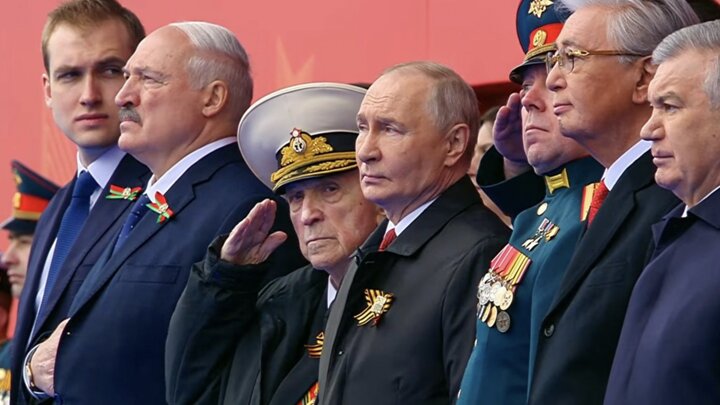
President Vladimir Putin in the stands at the Victory Day parade
Belarusian President Alexander Lukashenko, Malaysian King Sultan Ibrahim, Uzbekistan’s President Shavkat Mirziyoyev, and Slovak Prime Minister Robert Fico were among the foreign guests. Congratulating the participants, Putin said Soviet soldiers bore colossal losses to defend the “freedom and dignity” of the peoples of Europe. He noted that the Soviet people “restored sovereignty to those states that capitulated before Nazi Germany and became obedient accomplices in its crimes.”
‘A traditional day of pride’
On the annual occasion, Maxim Nachinov, leading editor at The Regional Newspaper in Russia, shared his views with the Tehran Times.
Maxim said Victory Day is “traditionally a day of pride, joy, and thankfulness.”
The Russian journalist said the occasion is contrasted with another World War II remembrance day, “the Day of Memory and Sorrow,’ which is observed on June 22. He noted, “That day marks the date when Germany invaded the Soviet Union. It is the day to remember all the terrible losses our country has suffered. But on Victory Day, everyone is cheerful; there are parades and fireworks all over the country. On this day, we celebrate our strength and unity.”
Over the past years, Russia has celebrated Victory Day amid its ongoing war with Ukraine, which began in 2022.
Ahead of this year’s commemorations, Russia and Ukraine agreed to observe a three-day ceasefire, announced by US President Donald Trump on Friday.
The struggle against the Wehrmacht
Russia has consistently underscored the decisive role of the Soviet Union in the defeat of Nazi Germany, stressing that the Red Army bore the main burden of the war and sustained the heaviest losses in the struggle against the Wehrmacht — the unified armed forces of Nazi Germany under Adolf Hitler from 1935 to 1945. About 27 million Soviet citizens lost their lives during the conflict.
Russia maintains that it was the Soviet military effort on the Eastern Front that broke the backbone of the German war machine and ensured its defeat in 1945, a historical narrative regularly highlighted in Victory Day commemorations.
Against this backdrop, Russian officials draw a direct link between the legacy of World War II and the current security situation in Europe. They argue that NATO’s continued eastward expansion and Europe’s extensive military and financial support for Ukraine have undermined the post-Cold War security framework and intensified confrontation with Russia. From Moscow’s perspective, these developments reflect a broader erosion of strategic stability in Europe, with Ukraine becoming the central arena of a wider geopolitical standoff between Russia and the West.
Leave a Comment